Showing posts with label Blair. Show all posts

Monday, July 28, 2008

Sweeny Div. Encamped


Marker Text:
July 21, 1864. Sweeny's division, Dodge's 16th Army Corps (US) was held in reserve some twenty four hours in a line that crossed the southwest area of Candler Park.
These troops, of McPherson's Army of the Tennessee, had moved from Decatur toward Atlanta the day before and being crowded out of line, were halted here in rear of the 15th Army Corps (astride the railroad at Whitefoord Avenue). The right of Sweeny's line connected with the left of the 23rd Army Corps (Moreland and Ponce DeLeon).
July 22. Sweeny's troops where shifted south of the Georgia railroad to prolong McPherson's left in East Atlanta- a move that blocked Hardee's (CS) rear attack on Blair's 17th corps.

044-37 Georgia Historic Marker erected 1985
Location: McClendon Avenue at Candler Park
GPS:
Visited: June 26, 2008

Here we are in Candler Park on McClendon Avenue. Now it is a day prior to the start of the Battle of Atlanta and Sweeny's men are camped here before they march south to the "Sweeny Marches South" and "The Battle of Atlanta Began Here" markers. This move would have been a relatively directly southward march that takes them through the "Noon Under the Trees" area at Whitefoord Avenue.
Sweeny had apparently been brought up through Decatur and may have been involved in the capture of Decatur.
So, again, although nothing of the battle itself took place here in Candler Park, the prologue is becoming clearer. Now we know some about where Sweeny's men came from.
The area from Candler Park to the intersection of Moreland and Ponce is close to 3/4 a mile. That is a pretty large area so I would have to say that this was quite a few men in his Division.
Once I posted this marker to the historical marker database, the editor requested pictures of the Moreland and Ponce intersection. Apparently he does not realize how bad of an intersection that is, especially if you are trying to get a photograph. I will have to work on that one.
Next up I will take a ride down Moreland in search of Leggett's Hill, I believe that I may know the knoll or hill of which they speak.

Monday, July 21, 2008

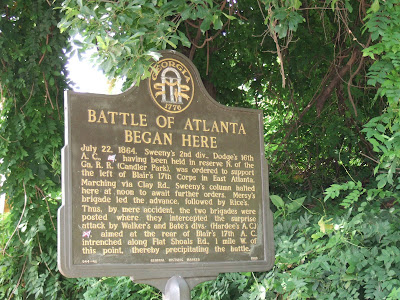
Battle of Atlanta Began Here


Well the title of the marker says it all. Imagine my surprise.


Text of the Marker - Verbatim, but translated by me without all the abbreviations.


July 22, 1864. Sweeny's 2nd division, Dodge's 16th Army Corp (US), having been held in reserve north of the Georgia railroad (Candler Park), was ordered to support the left of Blair's 17th Corps in East Atlanta.


Marching via Clay Road, Sweeny's column halted here at noon to await further orders. Mersy's brigade led the advance, followed by Rice's.


Thus, by mere accident, the two brigades were posted where they intercepted the surprise attack by Walker's and Bate's divisions (Hardee's Army Corps) (CS), aimed at the rear of Blair's 17th Army Corps intrenched (sic) along Flat Shoals road, 1 mile west of this point, thereby precipitating the battle.

Georgia Historic Marker Number 044-46 Erected 1983

Location: Clay Street at Memorial Drive
GPS:
Visited June 19, 2008

Alright before we get to the content of the marker and the significance of it, there are a couple of things that don't make sense to me from the information in this marker.
I presume that Mersy's and Rice's brigades were Union under Sweeny's command, but according to the marker they "led the advance." That wording makes it seem as though they charged the Confederate lines. The reality is probably more along the lines that they led the movement southward down along Clay road. In reality, this movement was spread out along front close to a mile or so long and was not only down Clay road. I will have to measure the distance to the Mersy's Brigade marker further west down Memorial Drive.
The second thing that doesn't make so much sense to me is the location of Blair's 17th Army Corps. The marker says that they were entrenched at Flat Shoals road, 1 mile west of this marker. The only way that Walker and Bate would be able to reach that area is if they were making a swinging loop around. The present day Flat Shoals road does not cross Memorial Drive and is close to a mile and a half away at this point. What were they doing all the way over here? They may have been trying to push up the Memorial Drive road towards Leggett's Hill, which was, from what I have gathered, near the intersection of Flat Shoals road and Moreland avenue in East Atlanta. That makes a little more sense because it would bring in the Confederates push directly into the rear of the Union lines. But it leaves the attacking force's right flank wide open for a counter attack. It would be a risky move. Especially given the fact that once the orders were written and dispatched, adjusting them was a difficult and uncertain task in the days of runners.
Okay, so here my perception changed again. What is defined as The Battle of Atlanta begins here, on the east side of Atlanta away from present day (and, I am sure 1864 day) downtown Atlanta.
Currently this is the in-town suburbs of Atlanta. This section is either in Kirkwood area, or directly south of the Kirkwood area. I wouldn't classify it as ghettos or slums, but it is economically depressed. The housing market here is sketchy. From the mid 1990s or so and on, several houses and areas near here have been renovated and updated in an effort to ride the wave of renovation that has struck several near by areas. But this area, like East Atlanta and Grant Park, are still hit and miss. But that has nothing to do with the battle or the markers.
Here is verification that my initial perception of the southeast attack from Chattanooga to Savannah is entirely incorrect. The encounter at Peachtree Creek, which precedes these events, is not included in the Battle of Atlanta, as per this marker. So now we have the Union, coming from the east and pushing south to cover a flank, being attacked by the Confederates who are marching north to attack to the west. Apparently everyone was in a state of confusion. I certainly am. These events warrant more investigation and information on troop movements prior to July 22, 1864 at noon.
Nevertheless, the two sides clashed here, along Memorial Drive, and the Battle of Atlanta had begun. Now I have used Memorial Drive as long as I can remember. It took me a long while to connect the end that crosses Interstate 285 and continues on towards Stone Mountain (I think that part is Cynthia McKinney Parkway now) to the end that passes the State Capitol. But it is a great thoroughfare. Never did I connect it with the battle though. I see it in different light now. I wonder if all of the people who live next to this marker (and the others as you will see) understand what happened here and how it has affected their black american community. Somehow I doubt that they know. I cannot guess if they would care.

Wheeler Delays Blair


One of the two markers that triggered this interest in the local historical markers.

Text of the Marker - Verbatim, but translated by me without all the abbreviations.
McPherson's Army of the Tennessee (US) seized Decatur July 19, 1864 and on July 20th moved towards Atlanta in two columns - the 15th and 16th Army Corps via the Georgia railroad, the 17th by roads south of it where Wheeler's Cavalry (CS), guarding the right of Atlanta's outer defense line, was posted.
Wheeler encountered Blair's 17th Army Corps at Clay Street and, in a contest lasting all afternoon, endeavored to halt it - both forces using artillery. Toward evening, Wheeler withdrew west to Leggett Hill, where he was relieved at Midnight by Cleburne's division (of Hardee's corp) (CS), which had been withdrawn from the engagement at Peachtree Creek for this purpose.

Georgia Historical Commission Marker Number 044-42 Erected 1956

Location: Hosea Williams Drive at Clay Street
GPS:
Visited: June 19, 2008

So here we are, at the first marker, but smack in the middle of the preliminary movements prior to the Battle of Atlanta. The Battle of Kennesaw Mountain was over, the encounter at Peachtree Creek was over, and Decatur was occupied by solders of the Union.
Now, at this point and time, I had always believed that the Battle of Atlanta happened in a rather linear fashion beginning at Kennesaw Mountain and continuing with the March to the Sea, southeast towards Savannah. So now, with the information on this marker, a flanking action to cut off the supply line and a push from the east towards a fortified city is described. This changes my perception and triggers some understanding of other markers that I had read along Dekalb Avenue where there were battles over the railroad line.
If, as I believed at the time, the battle followed a southeastern course, then those markers on Dekalb Avenue would have occurred after Atlanta had fallen. I had never been quite comfortable with the idea that the Union forces and the Confederate forces were still fighting over the railroad after the city had fallen. And I had never been comfortable with the idea that the Union commander did not sidestep the fortifications, attack at weak points, or siege the city.

So, from this marker, Union forces, after capturing Decatur on the east side of Atlanta, move towards the eastern defenses of the city and, along the way, encounter some of the defenders. The defenders delay the Union forces for an entire afternoon until they withdrawn to Leggett's Hill, where ever that is. The Confederate forces are relieved by another division that has come from the Peachtree Creek encounter.
Now when talking of the Battle of Atlanta, the encounter at Peachtree Creek is what comes to my mind, right after the Battle of Kennesaw Mountain. The area a little east of the actual battle area is currently called Peachtree Battle. So for the Confederates to remove a portion of the defenders there and shift them to the south east, the threat must have been significant, and possibly expected.


An assumption of mine from the text of the marker: A.C. equals Army Corps. While reading this, and some others, I originally mistook the A.C. for Armored Cavalry since the markers that I read dealt with cavalry corps. After some research, I latched onto the Army Corps translation.